


We built Roadbook: your whole cross-border road trip on one page
You're driving through five countries. Enter where from and where to, your passport and your vehicle, and a couple of minutes later you can see how long you and the vehicle can stay in each country, where to buy a vignette, what fuel will cost and where to sleep. A road trip planner without ten open tabs and sums in your head.

If you've ever driven across Europe through several countries, you know the scene. One tab has the route map, another the Schengen 90/180 rule, a third explains where to buy a vignette for Slovenia, a fourth shows what diesel costs in France, and a fifth tries to tell you whether your number plates will even get in. By tab ten, nobody remembers which one had the border where Schengen ends. So we built Roadbook to put all of it in one place.
A roadbook is your trip on a single page: the route day by day, plus everything you need to know about each country along the way. The word comes from rallying, where the co-driver guides the crew with a roadbook. Ours is a co-driver too. It works out visas for your passport, time limits for your vehicle, tolls, fuel, weather and places to stay. You drive.
Three questions instead of ten tabs
The Roadbook page has three steps. First, where from and where to: the countries on the way are worked out for you, you can add cities you'd like to pass through, and you can tick "both ways" so fuel and tolls are counted in both directions. Second, when you leave and how many hours a day you're happy to drive, anywhere from four to eight. No date yet? No problem. Roadbook will suggest the best day to set off based on the forecast for the coming week.
Step three is passport and vehicle. Visas depend on your passport, tolls on your vehicle class (car, van or camper up to 3.5 t, or a heavier motorhome), and the budget on fuel type, consumption and tank size. You can also ask it to avoid toll roads from the start. No sign-up needed: your passport and vehicle details stay in your browser.
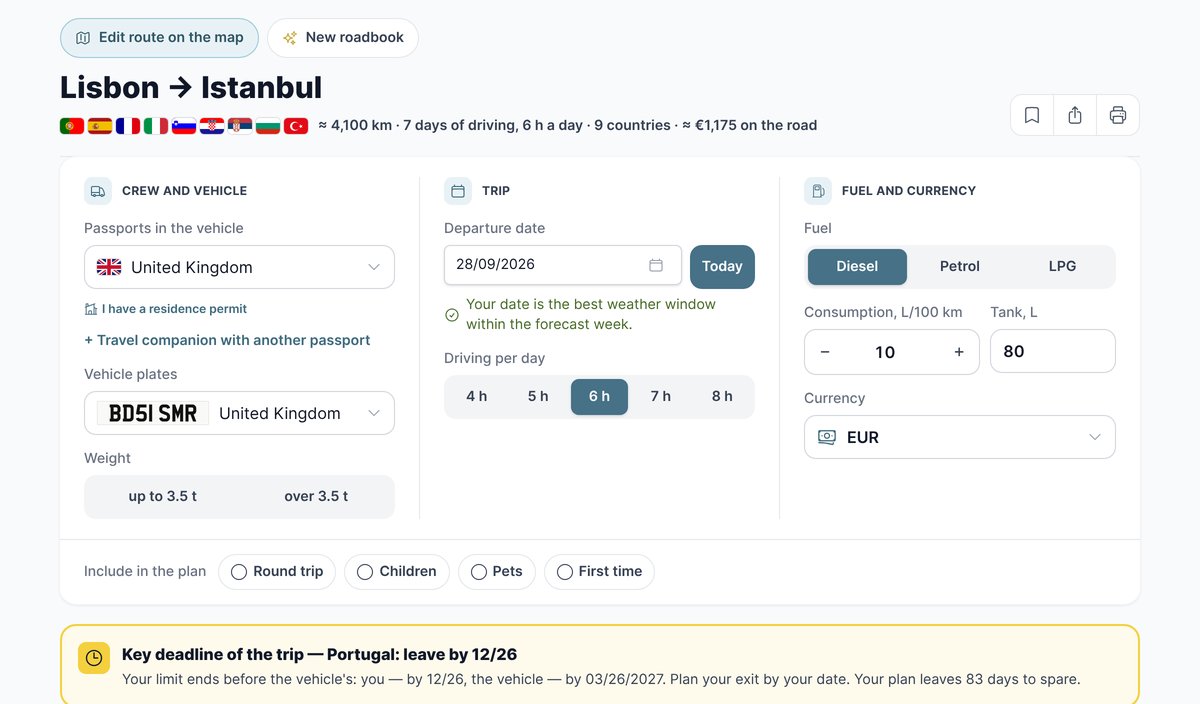
A couple of minutes later you get a finished roadbook with a permanent link. Bookmark it, send it to your travel companions, or print it for the glovebox — there's a print version and a PDF too. Dates, passports, vehicle and currency can all be changed on the page, and every setting lives in the link, so whoever opens it sees exactly the same plan.
The big question: how long can you and your vehicle stay
The most common mistake on a long road trip is counting days only for yourself. A vehicle on foreign plates has its own temporary import limit, and it doesn't match your visa. Roadbook counts both and puts a single key deadline at the top. For a Brit leaving Lisbon on 28 September, it reads: leave Schengen by 26 December, the vehicle is fine until 26 March. The person runs out first, not the car — and you can see that at a glance, no mental arithmetic required.
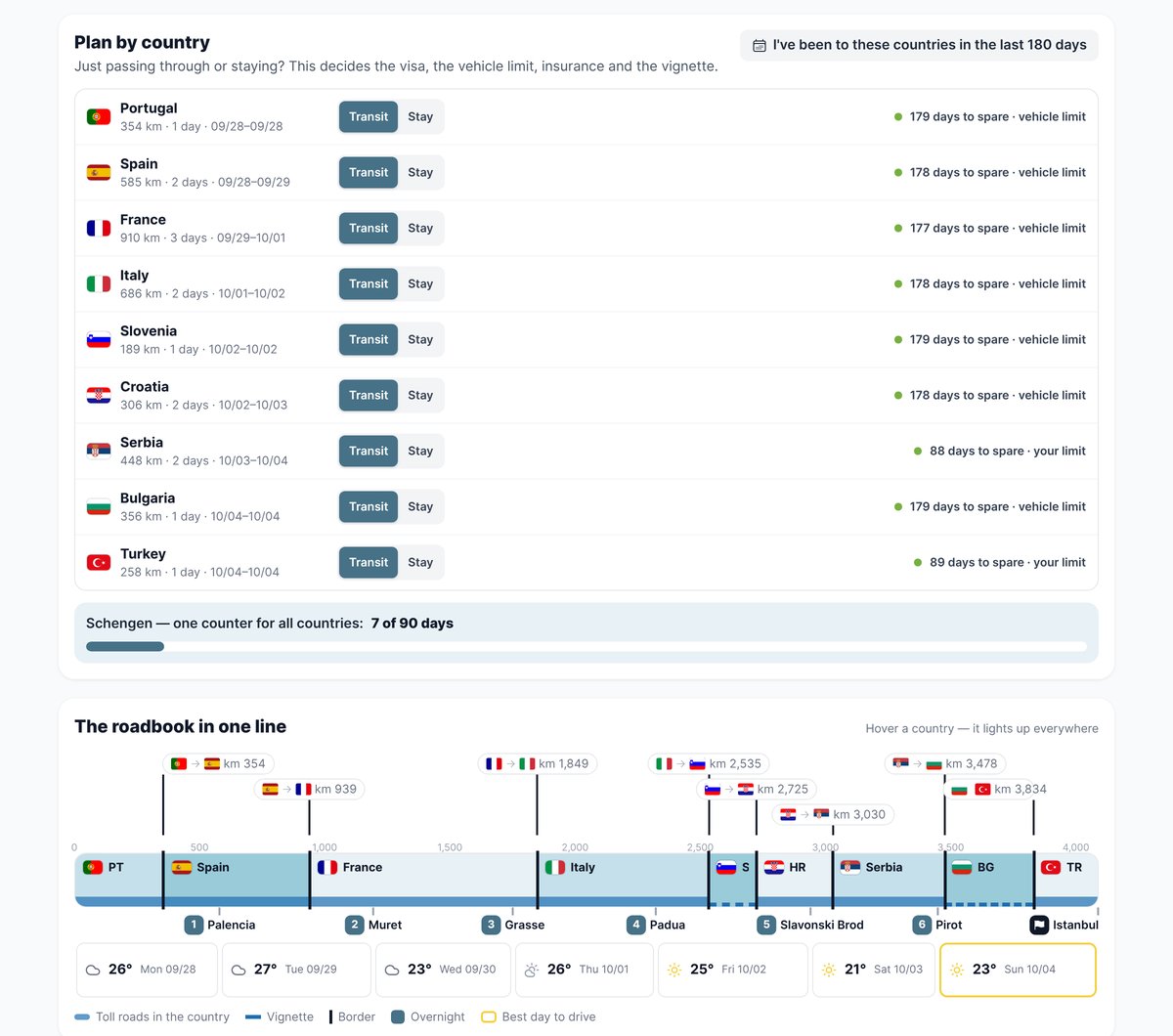
In "Plan by country", every country has a "Transit" or "Stay" switch. It drives the visa, the vehicle deadline, insurance and the vignette. Staying two weeks in Croatia? Roadbook recalculates how many days you have left. Schengen runs on one counter across all its member states: in our example that's 7 of 90 days. If you've been in those countries within the last 180 days, those days are pulled in from your visa log — the same counter as in the visa calculator.
Travelling with people on different passports? Add them as companions: each gets their own rules, and Roadbook sets the group's deadline by the strictest passport. If you hold a residence permit, mark it in the passport panel. A permit from a Schengen country opens all of Schengen visa-free, and in the issuing country itself there's no time limit. Roadbook will also warn you there that with a residence permit, temporary import of a foreign-plated vehicle often no longer applies.
The whole trip on one line
Under the plan sits a route ribbon marked in kilometres. It shows borders with their distance, overnight stops, stretches with tolls and vignettes, and below it the weather for every day of the drive plus a "best day to drive" marker. Hover over a country and it lights up everywhere: on the ribbon, on the map, in the tables.
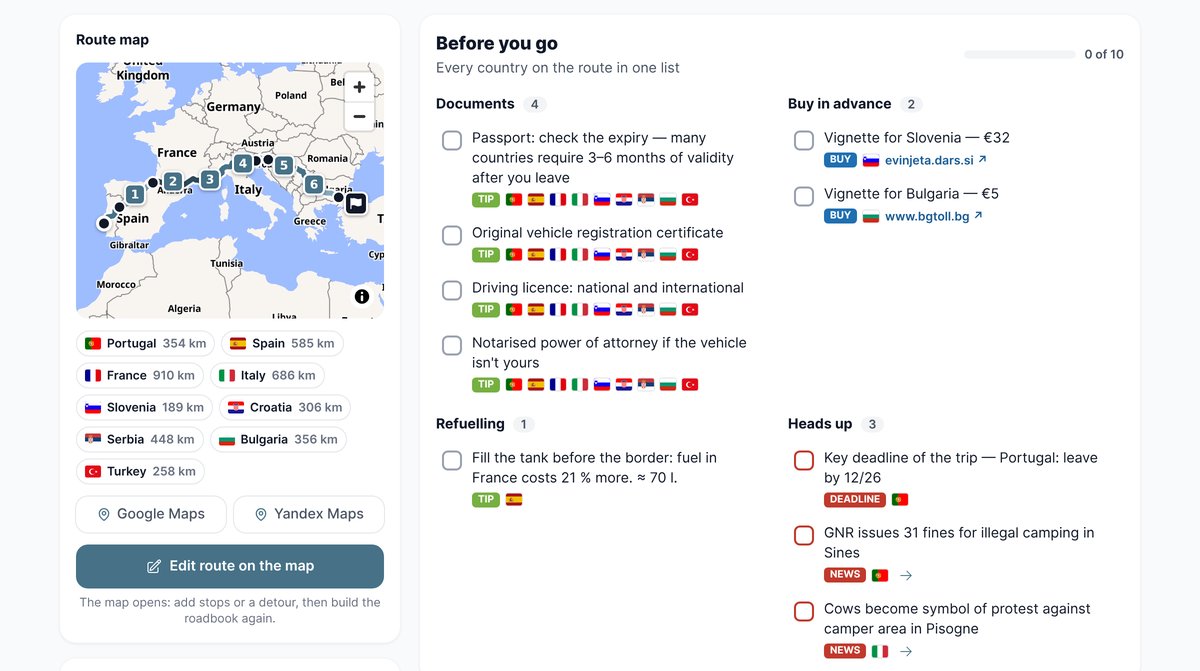
Next to it is a live route map with "Google Maps" and "Yandex Maps" buttons, so you can hand the route to your satnav. Want a detour or to skip a city? The "Edit route on the map" button opens the OpenVan map with your waypoints: add a stop, build a new roadbook.
A checklist that writes itself
The "Before you go" block pulls every country on the route into one list. Documents: a passport with enough validity left, the original vehicle registration certificate, your national and international driving licences, and a notarised power of attorney if the vehicle isn't yours. "Buy in advance": vignettes with prices and a link to the official shop — in our example, Slovenia for €32 and Bulgaria for €5. "Refuelling": where it pays to fill up before a border. Ahead of France, where fuel is 21% dearer, Roadbook suggests topping up with about 70 litres. And "Heads up": deadlines and fresh news that matter for a trip by car.
Travelling with kids or pets? Say so in the settings and the checklist adds its own items: the child's passport and notarised consent from the other parent if they're not coming along; a pet passport, microchip and a rabies jab at least 21 days before travel, plus a veterinary check on entering Schengen. The "First time" box switches on explanations of the jargon: what temporary import is, what a green card is, and why a vignette can be either a windscreen sticker or an electronic record linked to your plate.
Every country: ten answers on one card
Further down, the countries follow in order. Each card has the same ten rows, and a coloured strip on the right shows their status at a glance: green means all good, yellow means you need to do something, red means a ban or a deadline, blue means paid, grey means no data.
Visa — how many days your passport gives you and how they're counted. Vehicle — the temporary import limit, whether you need a carnet or a green card, and whether there's an entry ban for vehicles with your plates. Roads — specific toll sections priced for your vehicle class, plus vignettes. Fuel — price per litre, how many litres this stretch will take, what that comes to in money, and whether it's cheaper to hold out until the next country.
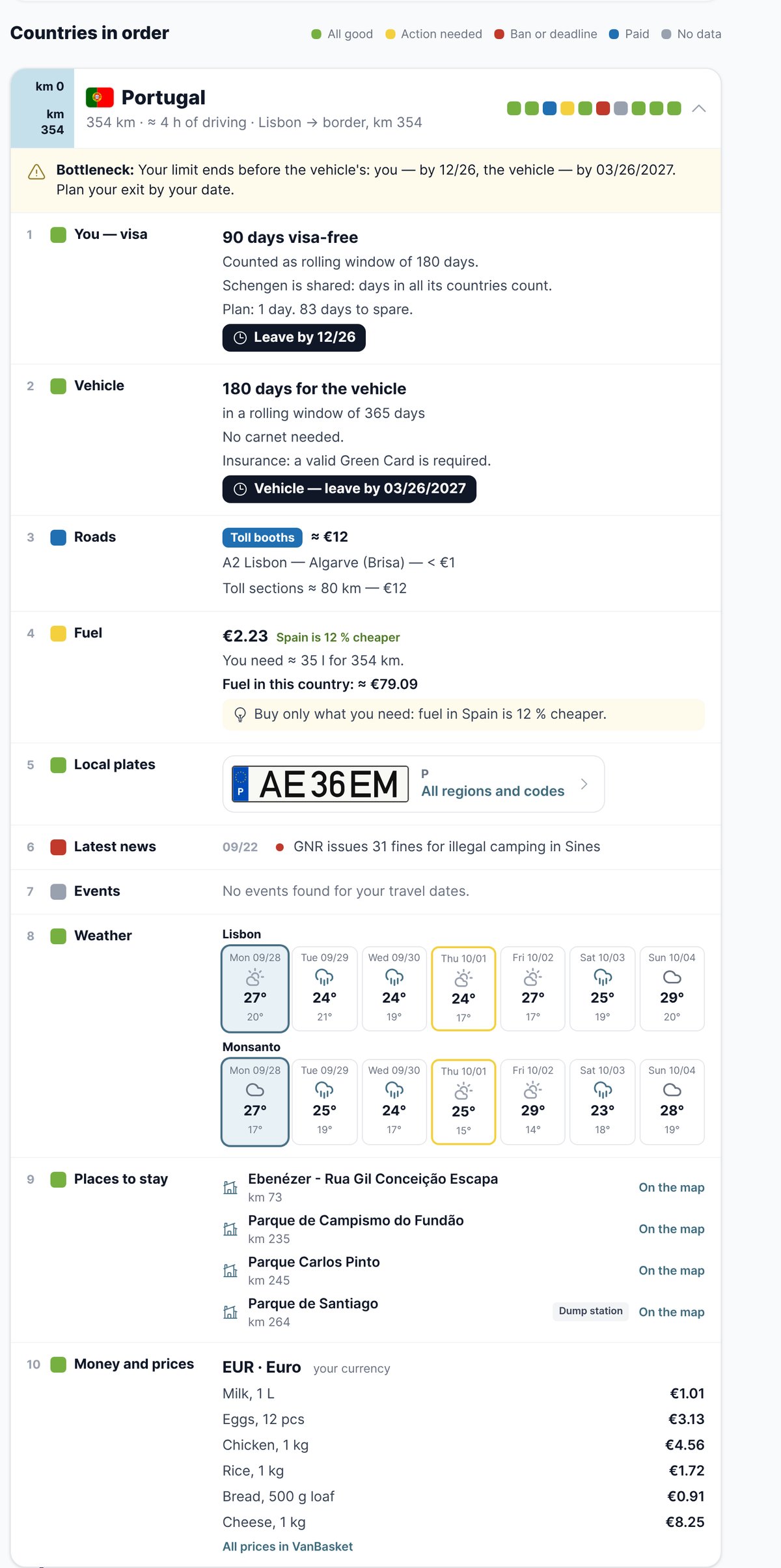
Local plates — what the local number plates look like, with a link to every region and code in our world licence plates section. Latest news — fines, closures and parking bans from the OpenVan news feed. Events — festivals and shows in the country on your travel dates. Weather — the forecast for cities in that country. Places to stay — campsites and motorhome aires no more than three kilometres off the road, marked for water, electricity and waste disposal. Money and prices — the local currency, its rate against yours, and prices for milk, bread, eggs and chicken from VanBasket: in Turkey, for instance, you see both 87.5 lira and €1.57 for a litre of milk.
Between the cards sit the borders themselves. "Internal Schengen border — usually no checks" or "Leaving Schengen: a stamp, the 90/180 counter stops." Small things, but a calm day on the road is made of exactly those.
Weather along the whole route, not just at the finish
The forecast at your destination tells you very little about the road over the Pyrenees. So Roadbook pulls weather for every overnight stop and for larger towns every 150 km along the route. The first seven days are the forecast; beyond that it's "usually on these days": the median for 2023–2025. The cell where your plan puts you on a given day is outlined, so you can see which rain you'll actually be driving through, not just what the city gets in general.
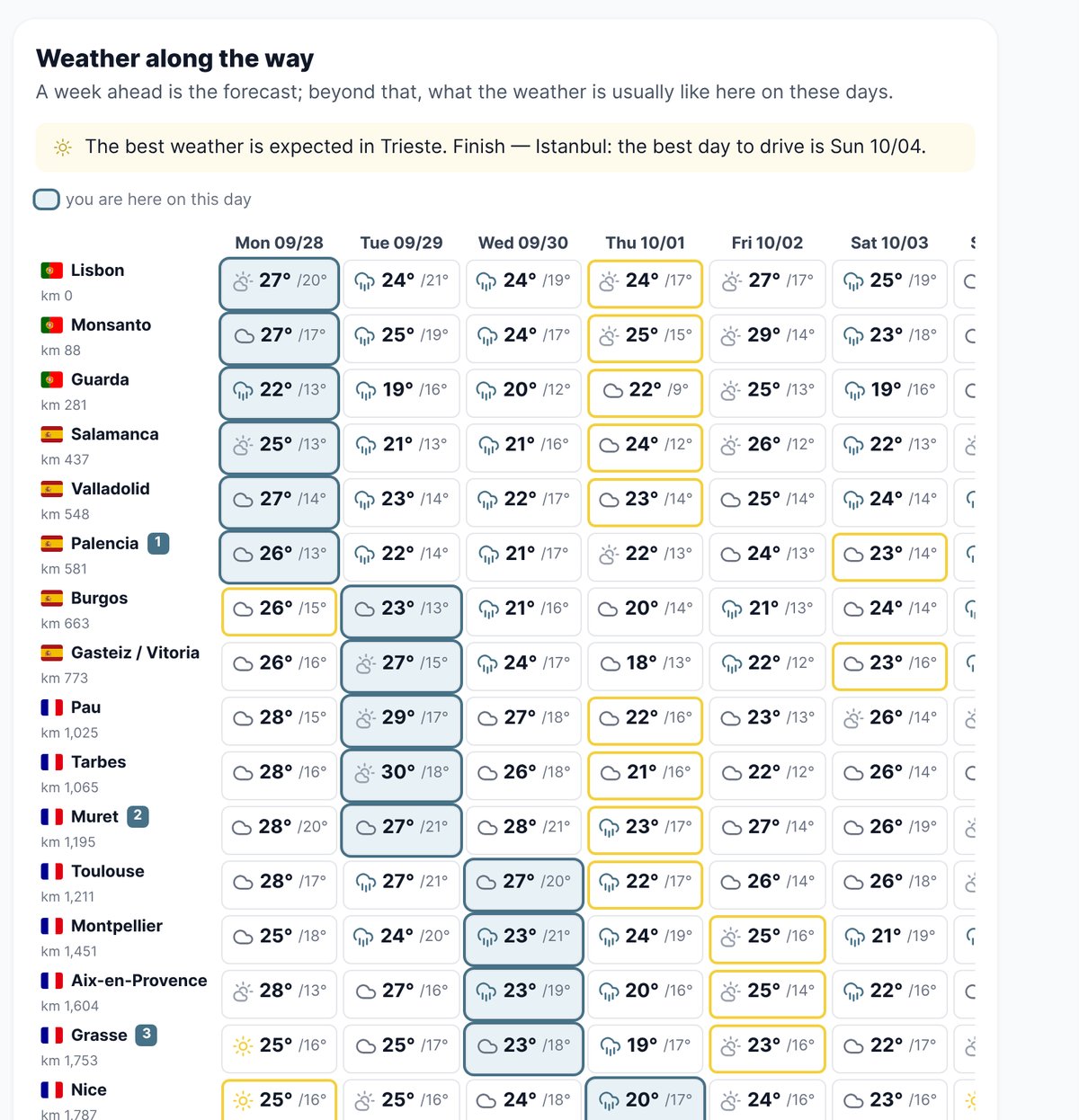
Leave the date blank and Roadbook finds the best weather window within the forecast week: "leave on Monday — rain on about 1 of 7 days, around +24 by day." If you've already picked a date, it checks whether setting off a day or two later would be drier or warmer. One click moves the date, and the whole plan — deadlines, weather, time limits — rebuilds around it.
What the road trip costs — by country, in your currency
At the end comes the on-the-road budget: fuel for your consumption, tolls and vignettes for your vehicle class, broken down by country with a total. In effect, a road trip cost calculator built into the plan. Lisbon → Istanbul in a diesel van doing 10 l/100 km comes to roughly €1,175: €872 on fuel, €265 on tolls and €37 on vignettes. The priciest country on the way is France: €330 for 910 km, €114 of it on toll motorways.
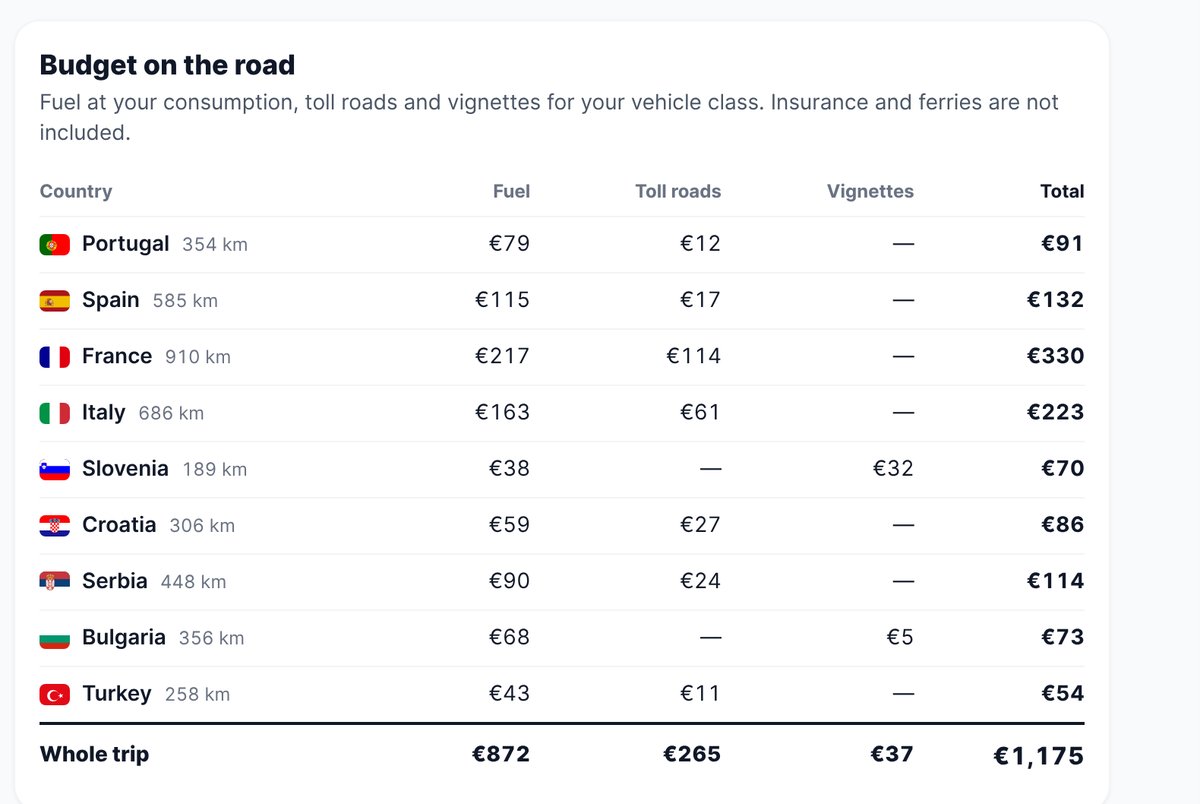
You choose the currency — roubles, lira, dollars, any currency the site supports. Rates are converted on the fly from fresh data rather than baked into the page when it's built.
How a roadbook is put together
The route is plotted on OpenStreetMap roads via OSRM and OpenRouteService, then split by country along the real border geometry. Crossing points come from a database of 9,475 crossings from OpenStreetMap; places to stay come from our places layer within a 3 km corridor of the road. Visa rules come from our visa section: 199 passports and some 39,600 passport–country pairs, with vehicle temporary import limits and plate-based bans from the same source. Tolls and vignettes are priced from our own directory of road operators, maintained by the OpenVan.camp Editorial team: the price is for your vehicle class, not "a car's price times a multiplier". Fuel comes from our fuel prices section; weather from VanSky, built on Open-Meteo, and ERA5 climate data from Copernicus. The whole calculation runs in one place on the server, and at the bottom of every roadbook there's a "Sources and check dates" block, so you can see how current each figure is.
What not to expect
Roadbook is a guide, not legal advice. Entry and vehicle import rules change, so check the time limits against official websites before you go — the cards link to them. The budget doesn't include insurance or ferries. The forecast is only honest for seven days; after that it's statistics from past years. For some countries we don't have data yet, and there the row is grey and marked "no data" rather than showing a made-up number. The route of a finished roadbook doesn't change: a different route means a new roadbook with a new link.
To see how it looks, try the ready-made examples: Lisbon → Istanbul, Munich → Split, Berlin → North Cape, Moscow → Almaty and two more routes on the Roadbook page. They adjust to your passport and vehicle on their own.
Roadbook won't make the border queue shorter or the vignette cheaper. It just means you no longer have to remember which of ten tabs had the date you need to be out by.